





Monolithization in Aerospace and Space, Printing Multi-Part Assemblies as a Single Component
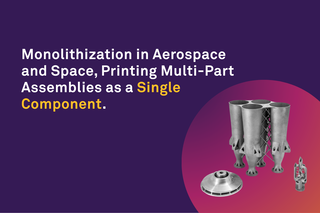
The aerospace and space industries have seen a significant shift towards monolithic structures. Traditionally, these industries relied on multiple individual components to form complex assemblies. Today, however, additive manufacturing is enabling the consolidation of parts into a single component, which leads to significant improvements in production efficiency, design flexibility, and reliability. By eliminating the need for separate parts and connectors, manufacturers can achieve more streamlined designs with fewer potential failure points, ultimately enhancing the structural integrity of the final products.
In this blog, we will discuss how part consolidation in aerospace and space applications is driving innovation, improving performance, and reducing production complexities. We’ll explore the role of additive manufacturing in achieving these benefits and how techniques like topology optimization and DFAM (Design for Additive Manufacturing) are pushing the boundaries of traditional manufacturing.
Understanding Multi-Part Assemblies vs. Monolithic Designs
The difference between traditional multi-part assemblies and monolithic designs lies primarily in the approach to manufacturing. Let's explore how these two approaches differ and when one might be preferred over the other.
Multi-Part Assemblies
Traditional multi-part assemblies involve several individual parts that are manufactured separately and then assembled to create a functional component. This approach typically comes with certain challenges:
Complex Logistics: Managing the production and assembly of multiple individual parts can be cumbersome.
Longer Assembly Time: More time is required for assembling the different components.
Risk of Component Failure: The more parts there are, the greater the risk of failure at the joints or connections.
Monolithic Designs
Monolithic designs, in contrast, integrate all the components into a single piece, often using advanced techniques like additive manufacturing. This method provides several key advantages:
Reduced Assembly Time: Since no multiple parts are needed, assembly becomes faster.
Improved Precision: Monolithic structures are produced as a single unit, ensuring greater accuracy.
Complex Geometries: The ability to create intricate geometries and internal structures that would be difficult or impossible with traditional manufacturing methods.
Durability and Reliability: In high-stress environments like aerospace and space applications, monolithic designs enhance the durability and reliability of components by minimizing failure points.
The Role of Additive Manufacturing in Simplifying Design
Additive manufacturing has become essential for simplifying the design and production process, particularly in industries like aerospace and space, enabling the creation of parts tailored with precision and innovative designs that were once impossible or highly complex with traditional methods. This approach not only reduces the need for multiple components but also improves the overall functionality and performance of the final product. The connection between Design for Additive Manufacturing (DFAM) and topology optimization lies in how they both contribute to creating highly efficient, lightweight, high-performance components while minimizing material waste and production complexity.
Design for Additive Manufacturing (DFAM): DFAM principles focus on designing parts specifically for 3D printing. By leveraging the unique capabilities of additive manufacturing, such as the ability to create complex shapes, components are optimized for better functionality and easier production. DFAM helps eliminate traditional constraints like assembly considerations, allowing for parts that are lighter, stronger, and more reliable.
Topology Optimization: This technique ensures parts are designed with the least amount of material while maintaining the necessary strength and durability. By optimizing the structure of the component, topology optimization reduces weight without compromising performance, which is especially crucial in aerospace, where minimizing weight is essential for efficiency and cost-effectiveness.
Together, DFAM and topology optimization accelerate the design process, reduce production time, and result in parts that are stronger, lighter, and more functional, adding significant value to aerospace and space projects.
Part Consolidation Streamlining Production and Reducing Complexity
Consolidating multiple parts into a single component offers significant benefits in production efficiency and overall product performance. By shifting from traditional multi-part assemblies to monolithic structures, the manufacturing process becomes simpler, faster, and more cost-effective. This transition reduces complex assembly procedures, minimizes human intervention, and lowers the potential for errors.
A major advantage of part consolidation is the reduction in failure points. Fewer parts mean fewer connections, joints, or fasteners that could fail under stress. This not only improves the product's reliability and durability but also simplifies the supply chain and inventory management. By utilizing additive manufacturing to consolidate parts, manufacturers can create intricate internal geometries and structures that would normally require separate components, streamlining production while enhancing precision and consistency.
In sectors like aerospace, where the performance and reliability of each part are critical, part consolidation improves manufacturing efficiency and long-term product reliability.
Real-World Examples of Lightweighting Through Part Consolidation
The advancement of additive manufacturing allows for more efficient designs, reducing the weight of components without compromising strength. By consolidating parts, manufacturers can create lighter, more durable components, achieving significant improvements in performance, especially in high-demand industries like aerospace and space. This approach streamlines production, reduces material use, and enhances overall functionality.
Case Study 1: Wipro 3D’s RF Feed Antenna for GSAT-19 Satellite
The RF feed antenna for the GSAT-19 satellite was traditionally manufactured from multiple parts that required assembly, adding weight and complexity. By utilizing additive manufacturing, Wipro 3D re-engineered the antenna as a single, integrated part, reducing weight, improving strength, and enhancing RF efficiency. The new design passed rigorous testing, including assembly vibration, climatic, and RF tests, and was successfully deployed on India’s largest satellite. This consolidation also minimized the potential for joint failures, improving reliability.
Case Study 2: Wipro 3D’s High-Pressure Compressor Stator for Aerospace
The high-pressure compressor stator was traditionally assembled from multiple parts, requiring complex assembly. Through metal additive manufacturing, Wipro 3D created the stator as a monolithic component, improving performance and reducing weight. After 150+ hours of testing in a prototype jet engine, the stator demonstrated outstanding durability. The redesign reduced the redesign-to-realize lifecycle from 14 months to just 5 months, accelerating production and increasing reliability.
Evaluating When to Transition to Monolithic Designs
Deciding when to transition from traditional multi-part assemblies to monolithic designs requires careful evaluation of several factors. This decision is not one-size-fits-all and varies depending on the project, industry, and long-term goals. Below are key considerations to guide this transition:
Cost-Benefit Analysis
Assess whether the long-term savings from reduced parts, assembly, and labor outweigh the higher initial design costs, particularly for low- to medium-volume production.
Production Volume
Single-component designs are more cost-effective in low-volume or prototype production. For high-volume runs, traditional manufacturing may still be more efficient unless additive manufacturing offers clear advantages.
Complexity Thresholds
If the design complexity drives up weight or cost without improving performance, simplifying to a single part can streamline production and reduce costs.
Long-Term Maintenance and Reliability
Fewer parts mean fewer failure points, leading to increased durability and reduced maintenance needs. This is particularly beneficial for high-stress environments like aerospace, where reliability is critical.
Industry-Specific Needs
In sectors like aerospace and space, reducing part count and weight can improve performance. In industries like automotive, reducing complexity can speed up production and lower costs.
Conclusion:
The shift to monolithic designs through additive manufacturing enables industries to create lighter, stronger, and more efficient components. With technologies like topology optimization and DFAM, these designs offer precision and performance that traditional methods cannot match, addressing the growing demand for reliability, reduced weight, and faster production.
At Wipro 3D, we provide advanced 3D printing solutions in both metal and polymer, ensuring quality, performance, and consistency. Our capabilities include LPBF, FFF, MJF, and DLP, with end-to-end services from design optimization to post-processing, making the transition from prototyping to full-scale production seamless.
Contact us today to see how Wipro 3D can help optimize your designs and accelerate your production.