




Rethinking Flow Control with Additive Manufacturing
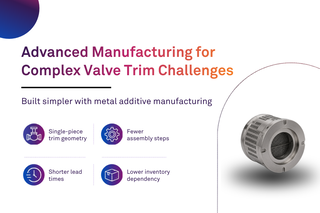
How advanced metal additive manufacturing is reshaping valve trims, flow-control internals, and industrial performance
In industrial flow-control systems, performance is often shaped by components that receive very little attention until they become a bottleneck. Valve trims, disc stacks, flow-control internals, impellers, and other complex flow-path components operate in demanding conditions where efficiency, precision, durability, and lead time can quickly become major operational concerns. For many of these parts, conventional manufacturing has historically imposed limits on what can be designed, how fast it can be produced, and how economically it can be supplied.
From Manufacturing Constraint to Design Opportunity
Additive manufacturing changes that equation. With metal additive manufacturing, engineers are no longer forced to simplify a component because of machining limitations or assembly complexity. Instead, they can begin with what the application demands: controlled flow paths, better pressure management, integrated features, lower part count, and improved overall performance. This is especially relevant in flow-control applications, where internal geometry is central to function.
Across the industry, additive manufacturing is increasingly being used for complex valve trims, retrofit components, and advanced flow devices. Industry examples from companies such as IMI Critical Engineering and Emerson show how additive manufacturing can enable improved flow control, lower maintenance burden, and more responsive replacement strategies in critical industrial applications.
Where Additive Manufacturing Creates the Most Value
Not every industrial part is a good candidate for additive manufacturing. The strongest opportunities tend to be components where geometry drives function, where internal flow paths are difficult to machine, where multiple parts can be consolidated, or where conventional lead times and supply chains create friction. In flow-control applications, this often includes valve trims, rotary and globe valve trim architectures, disc stacks, flow-conditioning features, and selected impeller designs.
These are precisely the kinds of applications where additive manufacturing can do more than simply replicate an existing part. It can enable a redesign that improves flow behavior, reduces assembly interfaces, and embeds functionality directly into the component. Multi-stage paths, tortuous flow channels, integrated features, and monolithic structures become more feasible, allowing engineers to design for performance first and manufacture second.
Why Flow-Control Components Are a Natural Fit
Flow-control components often sit at the intersection of materials engineering, fluid dynamics, and manufacturability. They need to deliver predictable performance while operating reliably over time. In conventional production, achieving this balance can require multiple machining operations, intricate assemblies, specialized tooling, and long qualification cycles. Additive manufacturing opens a different path by making complexity more manufacturable.
The ability to create fine internal features and highly controlled flow paths is especially valuable in valve and flow-control design. Additively manufactured trims and retrofit internals can help address performance limitations, simplify complex assemblies, and open up new design possibilities that are difficult to achieve through conventional methods. This is where metal additive manufacturing can move beyond replication and become a true design enabler.
The Value Goes Beyond the Part
The case for additive manufacturing is rarely just about printability. The real value often emerges across the broader system: fewer assemblies, fewer suppliers, simplified manufacturing routes, reduced inventory exposure, and faster response for low-volume or high-complexity parts. In some situations, it also enables a digital inventory model where a qualified design can be produced when needed instead of being physically stocked for long periods.
This matters in industries where uptime, maintenance responsiveness, and spare-part availability influence operational continuity. Flow-control parts are often high-complexity, lower-volume components that can be difficult to source quickly. Additive manufacturing offers a way to reduce dependence on conventional manufacturing bottlenecks while opening up new design possibilities that improve performance at the same time.
What Successful Adoption Requires
Adopting additive manufacturing successfully in flow control is not as simple as taking a legacy design and printing it. The strongest outcomes come from a structured engineering approach that starts with application selection and continues through design adaptation, material choice, manufacturability assessment, post-processing strategy, inspection planning, and qualification thinking. Internal channels, support removal, thermal behavior, surface finish, and repeatability all need to be addressed early in the development process.
This is where experience matters. Responsible application of additive manufacturing in industrial systems requires more than machine access. It requires DfAM capability, process understanding, material knowledge, inspection discipline, and the ability to align design freedom with production reality. The most successful applications come from combining engineering judgment with the right additive manufacturing strategy.
How Wipro 3D Approaches the Opportunity
At Wipro 3D, we see additive manufacturing not as a standalone production technology, but as an engineering and business transformation tool. The right applications are those where design complexity, production constraints, or supply-chain inefficiencies create a case for doing things differently. Our approach begins by identifying parts that can benefit from additive manufacturing in practical terms, then working backward through redesign, manufacturability, validation, and deployment.
This approach is consistent with Wipro 3D’s broader focus on helping customers move from prototyping to industrial adoption through consulting, design optimization, process development, production, and post-processing support. Public information about Wipro 3D highlights this end-to-end model across advanced metal and polymer additive manufacturing applications.
In flow-control components, that means looking beyond the immediate question of whether a part can be printed. The more important questions are whether it can be redesigned to perform better, whether it can simplify the production route, whether it can reduce dependence on multi-part assemblies, and whether it creates a stronger long-term value case for the customer.
The Road Ahead
As additive manufacturing matures, its role in industrial flow control is becoming clearer. The opportunity is not limited to faster prototyping or niche experimentation. It lies in enabling better-performing parts, more agile supply strategies, and more thoughtful engineering responses to applications that have long been constrained by conventional manufacturing.
For manufacturers, OEMs, and plant operators working with complex internals and demanding flow-control environments, the question is no longer whether additive manufacturing is relevant. The more useful question is where it can create measurable technical and commercial value. That is where the next wave of industrial adoption will be shaped.
Simplify Your Production Route Without Compromising Component Geometry
Don't let traditional machining limitations dictate your fluid dynamics. Discover how Wipro 3D consolidates multi-part flow internals into high-performance, monolithic structures.