




Conformal Cooling for Injection Moulding Tools: Where Metal 3D Printing Can Unlock Faster, More Reliable Production
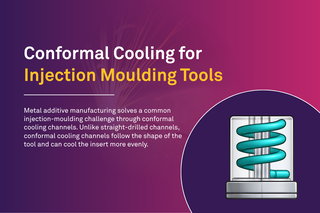
In injection moulding, a few seconds saved in every cooling cycle can translate into meaningful production gains. This is especially relevant for beverage, FMCG, and consumer goods manufacturers, where PET bottles, preforms, caps, closures, and plastic packaging components are moulded continuously, often on high-cavitation tools. Globally, beverage packaging is a large and growing market, with one industry report projecting it to grow from USD 157.7 billion in 2023 to USD 222.1 billion by 2030 [1]. For these injection moulding operations, the cooling stage is one of the most important productivity levers, and metal additive manufacturing enables conformal cooling channels in the mould insert that conventional drilling cannot achieve.
Why injection moulding tools are a strong fit for conformal cooling
Injection moulds and blow moulds used for packaging components are expected to deliver repeatability, dimensional consistency, fast cycle times, and long production runs. In PET preforms, neck finish accuracy, crystallinity control, and roundness are critical. In beverage caps and closures, high-cavitation productivity and consistent sealing performance are essential. In FMCG and consumer goods packaging, quality issues such as warpage, sink marks, and dimensional variation can quickly affect downstream filling, assembly, and brand perception, all of which trace back to how evenly the insert cools during the moulding cycle.
Conventional cooling channels inside these inserts are usually straight-drilled, which limits how closely they can follow the geometry of the moulded part. Metal 3D printing allows the cooling channel to be designed around the cavity or core surface instead, maintaining a more consistent distance from heat-critical zones. This reduces hot spots, improves thermal balance, and supports more stable moulding output.
What improves, and where
Conformal cooling affects three distinct layers of the injection moulding operation, and it's worth being precise about which is which:
Process: cooling time per shot is reduced, since the channel removes heat more efficiently from the insert. A 2023 Applied Sciences study reported a 30 percent cooling-time reduction compared with conventional cooling channels for the evaluated design [4]. This is an application-specific benchmark, not a universal guarantee.
Part: the moulded component itself shows reduced warpage and more consistent dimensions, since uniform cooling reduces internal stress as the part solidifies.
Production: with fewer dimensional defects, first-pass yield improves and scrap is reduced across a production run.
Industries served by this application
The application is conformal cooling for injection moulding inserts. The industries where this creates the most immediate value are:
Beverage brands and bottling ecosystems: PET preforms, PET bottles, blow-mould inserts, caps, and closures for packaged water, carbonated drinks, juices, and ready-to-drink beverages.
FMCG packaging: high-volume moulded packaging components for food, personal care, home care, and daily-use consumer products.
Consumer goods packaging: injection-moulded packs, lids, closures, dispensers, and related components where consistency and cycle time matter.
Mould makers and tool designers: PET preform designers, cap and closure manufacturers, and blow mould manufacturers serving beverage and FMCG customers, the primary audience for this application.
Where additive manufacturing adds value
Additive manufacturing is most valuable when used selectively for inserts, cores, and localised tool regions where conventional cooling is insufficient. The goal is not to replace every mould component with AM, it's to upgrade heat-critical zones with conformal cooling, while retaining conventional machining, assembly, and qualification practices wherever they are already effective.
Typical opportunities include PET preform core and cavity inserts, closure mould inserts, blow mould inserts, and complex cooling regions in FMCG packaging tools. Materials such as maraging steel 1.2709, H13, stainless tool steels, and copper alloy inserts may be considered depending on thermal load, wear, corrosion resistance, and post-processing requirements.
The business case
The strongest business case for conformal cooling is usually built around system-level value rather than insert cost alone. An AM insert may cost more than a conventionally machined one, but payback typically comes from three places:
Process: a shorter cooling cycle.
Part: reduced warpage and better dimensional stability.
Production: less scrap, higher yield
Together, driving higher output from existing machines.
Frequently Asked Questions
Ready to simplify cooling without compromising cycle time?
Don't let straight-drilled channels dictate your cycle time. Discover how Wipro 3D builds conformal cooling directly into your injection moulding insert, so heat leaves exactly where it should.