




How Quality Certifications Build Trust in Additive Manufacturing for Critical Industries
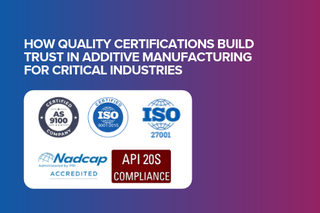
A successfully printed part is only the first checkpoint in additive manufacturing. For critical industries such as aerospace, defence, oil & gas, automotive, space, and medical, confidence comes from controlled processes, traceable materials, documented quality, and repeatable production. Certifications such as ISO 9001, AS 9100, ISO 27001, NADCAP, and API 20S help validate that additive manufacturing quality assurance is built into the system, not treated as an afterthought.
This blog looks at how quality certifications strengthen confidence in additive manufacturing and help critical industries move from printed parts to production-ready components.
Why Quality Certifications Matter in Additive Manufacturing
Quality Certifications bring measurable discipline into additive manufacturing. They confirm that the work behind every part is supported by defined process control, approved materials, qualified machines, trained operators, inspection checkpoints, and documented production records. For industries where a component must perform under demanding conditions, this evidence matters as much as the printed geometry itself.
For decision-makers, Quality Certifications make it easier to trust an AM partner for production-grade additive manufacturing, compliance-led projects, and long-term manufacturing programs.
From Printed Part to Qualified Part
A prototype proves that a design can be printed. A qualified part proves that the same design can be produced with control, consistency, and documented confidence. This distinction is important because additive manufacturing often begins with faster development, complex geometries, and design flexibility, while real industrial adoption depends on what happens after the first successful build.
Many AM projects start with faster trials and the ability to produce complex parts. But for critical industries, acceptance depends on part validation, production qualification, and repeatability across builds. AM production readiness is reached when a part is not only printed successfully, but also verified, recorded, and trusted for real operating conditions.
Why Critical Industries Cannot Compromise on Certified AM
For industries such as aerospace, defence, oil & gas, automotive, space, and medical, the decision to use additive manufacturing is closely tied to trust. A part may be designed well and printed accurately, but it still needs to meet the quality, documentation, and compliance expectations of its application.
Aerospace: Quality Certifications support safety, traceability, documentation, and repeatable quality, where every component must meet strict performance expectations.
Defence: Certified additive manufacturing helps address reliability, controlled production, and secure supply chain requirements, where inconsistency can create serious risk.
Oil & Gas: Parts used in oil & gas applications must support demanding operating conditions, compliance requirements, and dependable performance in harsh environments.
Automotive: For AM parts to move beyond prototypes, automotive programs need repeatability, scalability, cost control, and consistent quality across production.
Space: Space applications demand material efficiency, lightweight design, mission-critical performance, and documented confidence in every part.
Medical: Medical applications require compliance, validation, patient safety, and strict quality control before parts can be accepted for use.
This helps industry buyer assess whether an AM partner can support production-grade additive manufacturing with the right systems, records, and accountability.
The Role of a Certified AM Partner
For OEMs and industrial teams, selecting a Certified AM partner is closely linked to production confidence. The decision is rarely based on printing capability alone. Engineering teams need repeatability, procurement teams need supplier confidence, quality teams need clear documentation, and supply chain teams need reliability over time.
A certified partner brings these expectations into one controlled manufacturing approach. It helps buyer review the supplier with greater clarity, supports compliance-led procurement, and reduces uncertainty before additive manufacturing moves into larger production engagement. With Certified 3D printing services, organisations get a stronger foundation to scale AM applications because the process, records, approvals, and quality checks are already aligned with critical industry requirements.
Wipro 3D’s Quality Certification Benchmark
Wipro 3D stands as a strong example of how Quality Certifications can strengthen trust in additive manufacturing for critical industries. As Asia’s most certified metal additive manufacturing company, Wipro 3D has built its quality framework around reliability, compliance, and production discipline. It has been certified to ISO 9001, AS 9100, and ISO 27001 standards, reflecting our focus on quality management, customer & regulatory requirements, and information security.
Wipro 3D is the only company in Asia compliant with both NADCAP and API 20S, ensuring high standards across aerospace, oil & gas, and other critical industrial sectors. For customers, this creates greater confidence in working with a certified AM partner that can support quality-certified additive manufacturing through clear systems, controlled processes, and strong accountability.
Conclusion:
As additive manufacturing moves into more critical and production-led applications, Quality Certifications will play a larger role in how industries evaluate AM partners. They make the difference between trying AM for a single part and trusting it for repeatable, compliant, and production-ready manufacturing. For decision-makers, this confidence is important because every part carries expectations of reliability, traceability, and accountability.
For certified additive manufacturing support across critical applications, contact us to discuss your production requirements.
Frequently Asked Questions
Ready to Build Confidence into Every AM Part?
Move beyond a successful print with controlled processes, material traceability, documented quality, and repeatable production. Discover how Wipro 3D supports production-ready additive manufacturing for critical applications.