





HPDC Tooling: Using Additive Manufacturing to Cool the Parts of the Die That Matter Most
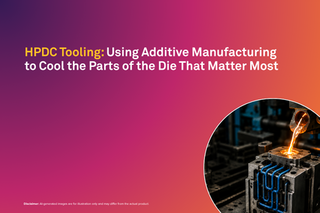
High-pressure die casting (HPDC) is a high-volume production route for aluminium, magnesium and zinc alloy parts, including housings, brackets, pump bodies, structural components and electrical or automotive castings. The process is fast and repeatable, but it places severe thermal load on die inserts, cores, sliders and core pins, especially where molten metal repeatedly heats localized regions of the tool [4].
In HPDC, temperature recovery, hot spots, soldering, porosity and thermal fatigue can become direct drivers of cycle time, maintenance effort and casting quality. A recent CAE study on HPDC cooling-channel design notes that die surface temperature must be maintained across the cavity to reduce casting defects and that optimized cooling-channel position and flow can improve surface temperature distribution [6].
This is where metal additive manufacturing becomes relevant. Laser powder bed fusion can manufacture internal cooling channels that follow a functional thermal path rather than a straight drilling path, allowing cooling to be placed closer to thermally constrained zones that conventional machining cannot reach [4].
Wipro 3D offers metal and polymer additive manufacturing with LPBF, FFF, MJF and DLP technologies, along with design optimization, simulation, post-processing and customized AM process development, which makes HPDC tooling inserts a relevant application-led opportunity [2].
Why conventional HPDC cooling is constrained
Conventional die cooling relies largely on drilled channels, baffles, bubblers and replaceable cooled cores. These methods are proven, but they are limited by line-of-sight machining and may not reach deep hot spots around thick sections, long cores, sliders, gate runners or narrow core pins.
When heat is not removed uniformly, the die can experience thermal gradients that contribute to heat checking, die cracking, aluminium soldering, dimensional drift, porosity and frequent repair. HPDC tool makers therefore evaluate cooling as a tool-life and quality lever, not only as a cycle-time lever.
The best-fit applications are replaceable tool components that fit within LPBF build envelopes, typically die cavity inserts, core inserts, sliders, gate or runner inserts, sprue bush inserts, ejector sleeve inserts, overflow or vent inserts and chill inserts. Full die halves are usually too large for a single LPBF build, so the value case should focus on localized components.
Where AM conformal cooling fits in the HPDC value chain
The HPDC tooling value chain usually starts with the automotive or EV OEM, flows through component design, die design and simulation, tool manufacture, tool assembly and validation, the die casting foundry and finally the OEM production programme. Wipro 3D can fit as the specialist AM tooling partner between HPDC tool design and tool assembly, supplying LPBF-built, heat-treated, machined and inspected inserts that integrate into the conventional tool build.
The decision makers are not only procurement teams. The technical buying group normally includes die designers, simulation engineers, tool room heads, foundry production heads, manufacturing engineering, quality teams and, in automotive programmes, APQP / PPAP stakeholders.
Material choice: H13 first for hot-work duty
For HPDC inserts and cores, AM H13 / 1.2344 is the preferred starting point because the application is a hot-work tooling duty involving cyclic thermal load, molten aluminium contact, soldering risk and thermal fatigue. Maraging steel can be considered for lower-severity trials, but it should not be the default material for high thermal-severity die casting inserts.
EOS lists tool steel materials for industrial 3D printing, including MS1, CX, 1.2709, CM55 and H13, and states that tool steel characteristics are relevant for tooling applications across industries [7].
The AM build should be treated as near-net tooling. Functional die surfaces still require heat treatment, stress relief, support removal, CNC machining, EDM where needed, polishing, hardness verification and final inspection before the insert goes into a die.
Validation workflow for a low-risk pilot
1. Select the right component: Choose one high thermal-load insert, slider, core pin or runner insert where repair frequency, soldering, porosity or cycle-time pressure is already visible.
2. Freeze the thermal case: Use HPDC simulation or thermal analysis to identify hot spots, channel path, flow rate, pressure drop, powder evacuation and minimum safe wall distance.
3. Build for inspection: Design channels for complete powder removal and plan CT scan, leak / pressure testing, flow testing, CMM inspection, density checks and hardness reports.
4. Qualify before scale-up: Compare the AM insert against the conventional component using die temperature, casting defects, repair events, cycle time, tool wear and maintenance downtime.
What published HPDC trials show
A ŠKODA AUTO case study reported a large LPBF slider of approximately 270 x 270 x 200 mm used in serial production of 1.0 TSI three-cylinder engine blocks, showing that relatively large AM tooling parts can be used in production HPDC environments [4].
The same case study reported 65% fewer tool-shop repairs and 63% fewer foundry repairs after the conformally cooled printed slider was introduced, supporting the link between better thermal management and lower maintenance burden [4].
The study also reported over 60% reduction in manufacturing lead time compared with the conventional slider, which is highly relevant when replacement tooling is delaying production readiness [4].
The cost comparison in that study showed a higher initial production cost for the printed tool than for the conventional slider, with the published case comparing EUR 48,371 for the AM slider against EUR 34,380 for the conventional slider; this supports a total-cost-of-ownership argument rather than a first-price argument [4].
An AM HPDC tool insert should be adopted on reduced maintenance, improved die life, lower casting defects, reduced downtime and cost per shot, not only on the price of the printed component.
The business case in India
The global HPDC market is forecast by Mordor Intelligence to grow from USD 42.53 billion in 2026 to USD 57.43 billion by 2031 at a CAGR of 6.19%, with Asia-Pacific identified as the fastest-growing and largest market [8].
For India, the automotive parts aluminium die casting market is estimated by Mordor Intelligence at USD 1.83 billion in 2026 and projected to reach USD 2.61 billion by 2031 at a CAGR of 7.29%, driven by passenger-vehicle growth, electrification and integrated casting platforms [9].
This points to a near-term opportunity in high-value, replaceable HPDC tooling parts rather than full-die replacement. A practical market screen should prioritize applications where high production volume, repair history, casting quality pain or die temperature control already creates a measurable ROI case.
Conclusion:
Conformal-cooled HPDC tooling is not a general replacement for conventional die manufacturing. It is a targeted answer for the regions of the die that drive hot spots, thermal fatigue, soldering, porosity, repair events and maintenance downtime.
A focused pilot can begin with one insert or slider, one thermal simulation, one AM H13 manufacturing route and one validation plan. If the T0 / production trial confirms better thermal control and lower maintenance, the same approach can be scaled selectively across high thermal-load parts in the HPDC tool portfolio.
References
[1] Wipro 3D Blogs & White Papers on Additive Manufacturing: https://www.wipro-3d.com/blogs/
[2] Wipro 3D official website, additive manufacturing capabilities: https://www.wipro-3d.com/
[3] ISO/ASTM 52920:2023, Additive manufacturing qualification principles: https://www.iso.org/standard/76911.html
[4] Andronov et al., Case Study of Large Three-Dimensional-Printed Slider with Conformal Cooling for High-Pressure Die Casting, 3D Printing and Additive Manufacturing, 2023: https://pmc.ncbi.nlm.nih.gov/articles/PMC10440664/
[5] Springer, Investigation of effect of conformal cooling inserts in high-pressure die casting of aluminum alloys: https://link.springer.com/article/10.1007/s00170-022-09808-7
[6] Manullang, Juang and Chuang, Analysis and Optimization of Cooling Channel Design of HPDC Process Using CAE, MCM 2025: https://www.avestia.com/MCM2025_Proceedings/files/paper/HTFF/HTFF_131.pdf
[7] EOS, Tool Steel for Industrial 3D Printing: https://www.eos.info/metal-solutions/metal-materials/tool-steel
[8] Mordor Intelligence, High-Pressure Die Casting Market: https://www.mordorintelligence.com/industry-reports/high-pressure-die-casting-market
[9] Mordor Intelligence, India Automotive Parts Aluminum Die Casting Market: https://www.mordorintelligence.com/industry-reports/india-automotive-parts-aluminium-die-casting-market