



Smart Features of the F300 Industrial 3D Printer That Keep Prints Running Without Supervision
In production environments, 3D printing reliability depends on more than machine capability. Filament runout, nozzle clogs, bed leveling inconsistencies, moisture exposure, and unmonitored temperature changes can each interrupt a build mid-process, wasting material and time while delaying the parts that were needed. Most of these issues occur when no operator is physically present at the machine.
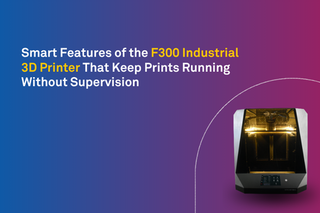
The Wipro 3D F300 industrial 3D printer is designed around this operational reality. It includes a set of built-in features that detect issues early, respond automatically, and keep operators informed without requiring continuous on-site supervision. This blog covers each feature, the problem it addresses, and how it functions.
1. Filament Runout During Active Builds
When the filament runs out before a job is complete, the machine continues moving but no material is deposited. Hours of print time are lost and the job has to be restarted from the beginning.
The F300's Smart Material Detection monitors filament feed continuously. When a runout is detected, the printer pauses automatically and sends a notification to the operator. The operator can load a new spool and resume the job from the point where it stopped, recovering the build instead of discarding it.
2. Undetected Nozzle Clogs During Printing
A nozzle clog occurs when material stops flowing correctly through the nozzle. The printer continues running, and the timer continues counting, but no material is being deposited. The part may appear complete externally, but will be structurally weak or hollow where layers were missed.
The same Smart Material Detection system that handles filament runout also monitors material flow in real time. When a clog is detected, the printer pauses and alerts the operator immediately, before the build is further compromised. The operator can then clear the clog and decide whether to continue or restart the job.
3. Bed Leveling Inconsistency Affecting First Layers
If the build platform is not correctly leveled, the first layer does not adhere properly. Variations in bed height cause uneven layer thickness across the base, and everything built on top of it is affected. This has a direct impact on dimensional accuracy, adhesion, and part quality.
The F300 uses a Kinematic 3-Point Automatic Platform Leveling system supported by an Intelligent Mesh Leveling System. Before every print, the machine measures the bed at multiple points, maps any height variation across the surface, and adjusts the print path to compensate without requiring any operator input. Every print begins on a consistently leveled surface, regardless of how the previous job ended.
4. Filament Moisture Exposure and Material Degradation
Filament absorbs moisture from the surrounding environment, which changes its printing behavior. Moisture-affected filament can snap during feeding, produce surface bubbling, create rough finishes, or result in parts with reduced mechanical strength. Engineering-grade materials such as Nylon, PC, and fiber-reinforced composites are particularly sensitive to moisture uptake.
The F300 includes an in-built material storage unit that maintains filament in a controlled, low-moisture environment with active humidity monitoring. Storage conditions are tracked continuously, not assumed to be acceptable. For teams printing with engineering-grade materials, the condition of the filament before it enters the nozzle directly affects the structural and surface quality of the finished part.
5. Particulates and Fumes in the Work Environment
When polymers are processed at high temperatures, fine particles and fumes are released into the surrounding air. For materials such as ABS and PC, which require higher processing temperatures, this presents a sustained environmental concern for operators working in the same space over extended periods.
The F300 includes a Dual Air Filtration System integrated into the enclosed print chamber. It filters particulates and fumes during the build process, keeping the work environment cleaner and safer for operators. A controlled internal environment also reduces contamination within the build chamber, which contributes to improved surface quality on the finished part.
6. Manual Nozzle Cleaning Between Print Jobs
After extended prints or material changes, residual material on the nozzle tip causes dripping, inconsistent extrusion lines, or surface defects on the next part. Left unaddressed, this introduces quality variation across successive builds.
The F300 includes a Nozzle Self-Cleaning Mechanism that performs automated nozzle cleaning between print jobs. This removes the need for manual intervention between builds, reduces downtime, and maintains consistent extrusion quality across the production run.
7. Remote Monitoring Across Unattended Print Cycles
Long print jobs run for hours. Operators managing multiple machines or working across shifts cannot remain physically present throughout every build. Without a way to check on the machine remotely, a failure that occurs early in a long job may go unnoticed until significant time and material have been lost.
The F300 has a built-in 5MP wide-angle camera with a 130-degree field of view covering the full build area. The live feed is accessible remotely through Wi-Fi or Ethernet. Operators can monitor the build in real time and pause or stop the print remotely if an issue is identified, without needing to be physically present on the production floor.
8. Thermal Instability Causing Part Distortion
Certain engineering materials are sensitive to temperature variation during the print process. Uneven cooling or thermal fluctuation within the build environment can cause warping, layer separation, or cracking. This is more likely in larger parts where upper layers are far from the base and more exposed to ambient temperature conditions.
The F300's enclosed print chamber maintains stable, monitored temperature conditions throughout the full build, not only during the initial layers. For materials such as PC, Nylon, and fibre-reinforced composites, this controlled thermal environment is what allows them to print reliably without distortion or structural failure.
Conclusion
Polymer 3D printing in India is shifting from theory to practical application. More teams have deployed the technology, clarifying exactly where it succeeds and where it falls short. The Wipro 3D F300 is built for teams that require reliable, automated production that runs without supervision. By addressing real-world challenges like filament runout, nozzle clogs, and environmental control directly, it handles what industrial use requires, rather than what looks good on a specification sheet.
To learn more or connect with our team, visit wipro-3d.com.