





Why Your Next Polymer 3D Printer Needs to Be Industrial-Grade
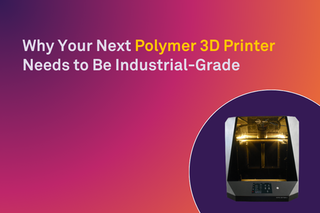
Nearly 1 in 3 desktop 3D printer owners report repeat print failures, nozzle clogs, or bed sticking issues as recurring problems. Material options on desktop machines are also limited, which creates a gap when engineering teams need parts that perform under real operating conditions rather than just demonstrate a concept.
At Wipro 3D, we often see this pattern. And it is exactly the gap the Wipro 3D F300 is designed to address - a Fused Filament Fabrication (FFF) 3D printer built for engineering teams that need reliable, repeatable output from engineering materials, day after day.
The Role of Polymer 3D Printing in Industrial Manufacturing
Polymer additive manufacturing has grown well beyond just making prototypes. Engineering and production teams today use it for functional fixtures, end-use components, jigs, and small-batch manufacturing. But as the applications have grown, so has the need for a machine that can keep up.
What industrial polymer printing requires:
Automated bed leveling to remove operator-dependent variability from every build
Real-time monitoring and automated leveling that ensure a seamless production workflow, catching errors before they cause costly delays.
A stable and controlled print environment, crucial for high-performance polymers
Material storage that keeps filament in condition and reduces downtime
Operator safety features that filter out harmful particles and fumes during printing
The F300 addresses each of these, and it is designed and made in India.
What Makes the F300 Built for Industrial Use
Enclosed, Temperature-Monitored Print Chamber: The F300's chamber maintains a stable and controlled environment throughout the build, which is crucial for printing high-performance polymers that require specific temperature conditions.
Inbuilt Material Storage with Smart Detection: The F300 stores filament in a low-moisture environment, keeping spools in condition and ensuring a smooth workflow. If there is a filament runout or a nozzle clog, Smart Material Detection pauses the build in real time and immediately notifies the operator, preventing failures before they happen.
Kinematic 3-Point Automatic Platform leveling: The Intelligent Mesh leveling System ensures precise and consistent leveling of the print bed before every job, improving print quality and reducing setup time.
Dual Nozzle with In-Situ Nozzle Lifting Mechanism (F300-2): The F300-2 allows for seamless switching between nozzles during a print job, enabling multi-material printing within a single build.
Nozzle Self-Cleaning Mechanism: Automatic nozzle cleaning minimises maintenance efforts and ensures consistent print quality across builds without manual intervention.
Dual Air Filtration: The dual filtration system filters out harmful particles and fumes generated during the printing process, keeping the work environment clean and safe.
Remote Monitoring and Control: A 5MP wide-angle camera and remote access capability allow operators to monitor and control print jobs remotely, enabling real-time adjustments from anywhere.
Materials
The F300 is compatible with a wide range of engineering-grade materials: PLA, ABS, ASA, HIPS, PET-G, Nylon (PA6, PA12, PA6-CF, PAHT-CF), TPU 90A and 95A, PC, PC-FR, and composites. Custom material printing is also supported.
Industrial Applications of the Wipro 3D F300
The F300 is not limited to one type of work or one sector. It is built for teams across industries that need parts to perform in real conditions, not just look good.
Automotive and Industrial: In automotive settings, the F300 is used to produce functional prototypes, demo models, jigs, and end-use parts directly on the production floor. Teams can print and test components quickly without waiting on external suppliers, keeping the product development cycle moving at a faster pace.
Aerospace and Defence: Aerospace and defence teams use the F300 to create precise, functional components where accuracy and material performance are non-negotiable. The printer's enclosed, temperature-monitored chamber makes it possible to work with high-performance polymers that would otherwise be difficult to print reliably on standard machines.
Oil and Gas: In oil and gas operations, parts often need to hold up under demanding conditions. The F300 supports engineering-grade materials like PC, Nylon composites, and carbon fibre-filled variants that are suited for components used in such environments, including housings, fittings, and structural supports.
Medical and Research Institutions: For medical device development and R&D centres, the F300 offers a controlled print environment and a wide material range that supports the creation of precise functional prototypes. Engineering and research teams can manage and monitor print jobs remotely, giving them more flexibility without compromising on output quality.
Not every polymer 3D printer is built for the same kind of work. A machine that handles basic models well may fall short the moment you need parts that hold up under heat, load, or repeated use. The materials a printer supports, how much operator time it demands each day, whether it can maintain the same output across multiple builds, and whether your team can keep an eye on it without being physically present - all of this shapes how useful the machine actually is once it is on your production floor. The specification sheet rarely tells the full story.
Conclusion
People are now talking about polymer 3D printing in India. More teams have used it, and we now know where it works and where it doesn’t. The Wipro 3D F300 is built for teams that have moved past basic modeling and require high-performance functional prototyping using engineering materials that perform consistently in a real manufacturing environment. Designed and made in India, it is a machine built around what industrial use actually requires, not just what looks good in a specification sheet.
To learn more or connect with our team, visit wipro-3d.com